
Legacy Beyond Leadership: A Journey of Character, Courage, and Conscience
Reflections from the Book Launch
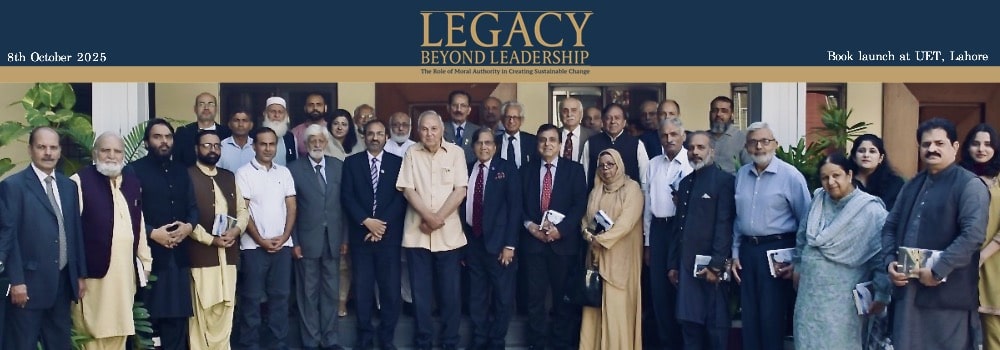
The launch of Legacy Beyond Leadership was held at the University of Engineering and Technology, Lahore, in early October. More than a book launching ceremony, it became a reunion and trip down memory lane for the Punjab University (PU) community. Retired professors from PU took turns reflecting on how the author’s leadership had touched their lives, through his compassion, attention to detail, and commitment to merit. Presided over by Prof. Dr. Shahid Munir, SI, Vice Chancellor UET Lahore, the event carried a sense of gratitude and reverence.
The central idea of the book, Virtuous Leadership, reflected in each tribute, validating moral authority as the purest form of leadership, essentially actions anchored in power of character and not the force of authority. The image below shows the author presenting his book to the Vice Chancellor, in the presence of some of the speakers at the event.
Why Legacy Beyond Leadership Matters Now
As a society, we have witnessed a slow yet steady erosion in terms of our collective conscience and social values over the past half-century. Unfortunately, we have successfully adjusted definitions to create new meanings out of concepts associated with values and virtues. Our youth, especially those within colleges and universities feel disillusioned and frustrated, in particular to find respect for morality and ethics. In absence of a deeper connection with the Qur-ān, we struggle to converge on definitions and drivers of influence within our social fabric. Legacy Beyond Leadership arrives as a rare addition to our local case studies on leadership and change, in particular within the public sector domain.
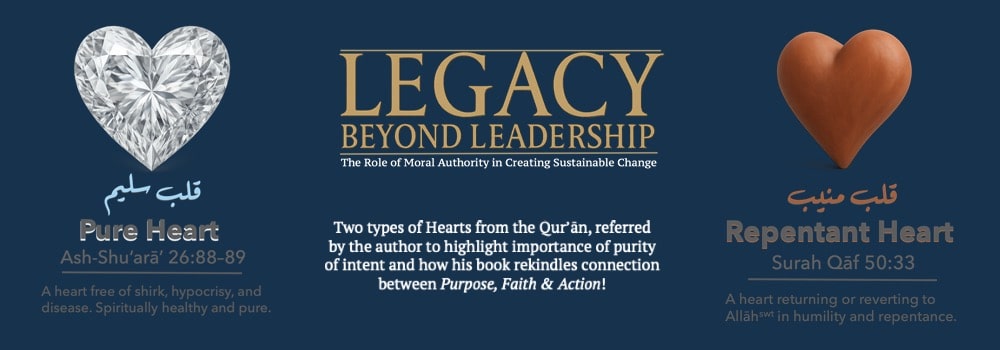
Meanwhile, book reading has also experienced steady decline, with social media, actively filling the void through audio-visual formats, promoting western narratives. This has created a low self-worth and conflicting definitions of morality and ethics. Legacy Beyond Leadership rekindles connection, between purpose, faith, and action. It presents a case study of turnaround of Punjab University during the 8 years of author’s tenure as Vice Chancellor. Across its chapters, references from the Qur’ān are linked with specific actions taken, suggesting that true reform is not beyond reach, if our intent is to seek the pleasure of Allāhswt, rather than approval or validation of people.
Legacy Rooted in Merit and Moral Authority
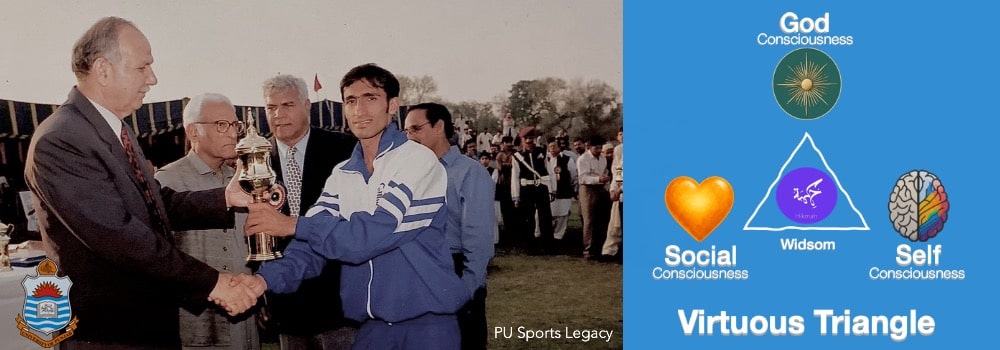
During his initial years as Vice Chancellor of The University of The Punjab, Lt. Gen. (Retd.) Arshad Mahmood, faced a turbulent environment and a deep-rooted institutional inertia. Apart from other academic and administrative actions, he equally prioritized system reforms as well as revival of community spirit. He leveraged transformation of Punjab University’s sports department into a model of merit and moral leadership for entire University. Sports, for him, were not extracurricular but foundational for an ailing educational institution. He believed sports were a springboard for developing future leaders, improving institutional culture, and rallying the PU community around shared pride. His structured interventions introduced transparency, monitoring, and merit-based selection that elevated PU to first place in national championships three years in a row (2004-2006). Guided by the Virtuous Triangle: God-consciousness, Self-consciousness, and Social-consciousness, this turnaround demonstrated that lasting change emerges where moral authority meets institutional discipline. It remains one of the most tangible examples of Legacy Beyond Leadership in action.
His 8-year tenure and the journey he undertook with the Punjab University community became the foundation for Virtuous Leadership, a philosophy where moral authority outweighs positional power. The book shares short stories from this period, showing how moral courage, not control, can turn-around even the most complex institutions.
Coming full Virtuous Circle
A war veteran decorated with Sitara-e-Jurrat for his courage in the 1965 War, the author of legacy beyond leadership carried his battlefield principles into academic corridors. His leadership philosophy elaborated in his book centers around what he calls Virtuous Leadership; explained at length through the Virtuous Circle (the 4G model) and the Virtuous Triangle – God-consciousness, Self-consciousness and Social-consciousness, detailed in the 15th Chapter of legacy beyond leadership. This model and associated values became the bridge that helped convert his military acumen into academic reform, showing that leadership, whether in command or in service, begins with character.
As leaders, we all struggle a different stages during our lives; transitioning from one industry to another or from a larger organization to a smaller one or sometimes vice versa. It is when the arena changes, so do the principles of engagement, however the core values must be kept alive and employed to build trust and ensure a smooth transition. Legacy Beyond Leadership offers valuable insights into this seemingly simple transition; however it reveals its depth and complexity as readers turn through the chapters. It reminds us that every transition, like every tenure, is part of a larger test; how one’s legacy will ultimately be counted, here or hereafter.
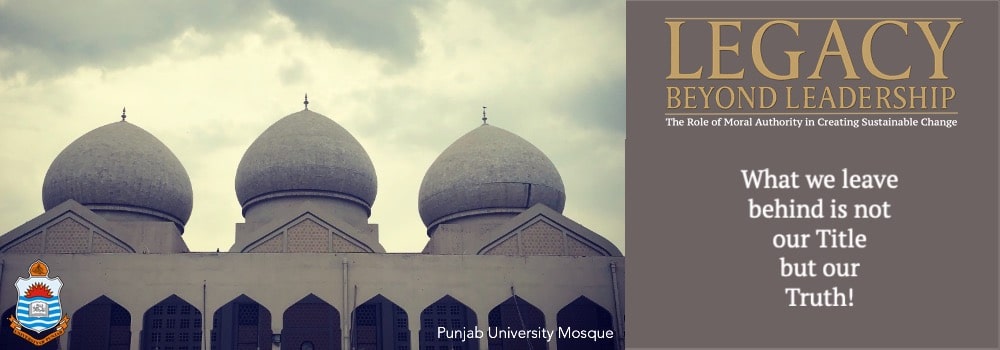
What we leave behind is not our title, but our truth
Legacy according to the author is the sum total of one’s life experiences driven by beliefs, values, traditions (good or bad) passed down or acquired; it is what you leave behind after your time here is up. In his book legacy beyond leadership, the author writes that every leader should be able to count their true achievements on their fingers – how would you like to be remembered when you leave your job, how would you like to narrate your life’s story to your children, grand-children, friends, relatives and others you know. And finally how would you like to narrate your life story to Almighty Allāh, who provided you an opportunity to make a difference.
Hence life’s purpose cannot be connected to our immediate goals or success defined materially. Legacy beyond leadership suggests that our life must revolve around a two-fold purpose or two simple pursuits: Worship and Servitude. Worship is to follow Divine Commandments to receive Guidance, while Servitude is protecting rights of others while creating ease for them. And that is the essence of Legacy Beyond Leadership; a reminder that what we leave behind is not our title, but our truth.
Carrying the Legacy Forward
Legacy Beyond Leadership is a call to readers, rethink purpose while working backwards from their exit in the role that they serve. The book is now available online through MILLS™ Skills while we try to make it available across Pakistan at book stores.
May this book rekindle reflection for leaders across academia and corporates, and remind us that the road to leadership begins with moral clarity and ends with service to humanity.