Featured verse from the Qur’an (Al-Isra 17:25) reminding us that true leadership begins with righteous intention.
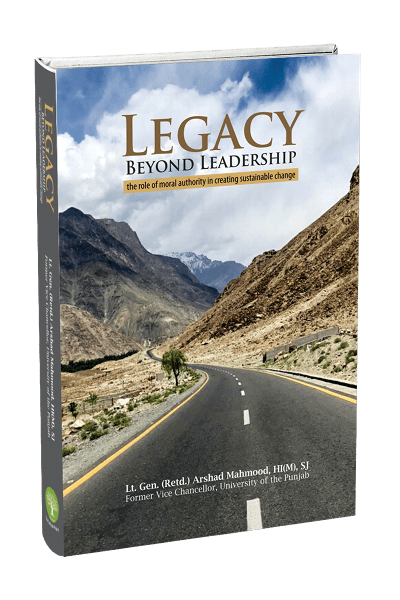
The Winding Mountain Road - Cover Image
Legacy Beyond Leadership
The cover image of Legacy Beyond Leadership shows a winding road disappearing into a mountain, depicting an uncertain journey, mirroring the path of life itself. It reminds us that leadership demands clarity on our purpose as we negotiate ambiguity in pursuit of the straight path on a winding road.
Clouds in the background reflect our inability to see beyond the present, requiring our heart’s compass to carve out a vision of the legacy we wish to leave behind, and staying true to it, no matter what life throws at us.
The darker mountains in the distance represent trials and tribulations that must be faced, and the Pockets of blue skies in the background symbolize Wisdom and Guidance, we must seek from Allāhswt, even when our judgement is clouded.
I chose this image, for it captures the spirit of my life, narrated as short stories in this book. At the heart of these stories is the concept of Virtuous Leadership, which are the foundational pillars for creating a lasting legacy; Self-consciousness, Social-consciousness, and God-consciousness. I have dedicated an entire chapter to this subject, connecting dots in retrospect across my stories with each of these pillars.
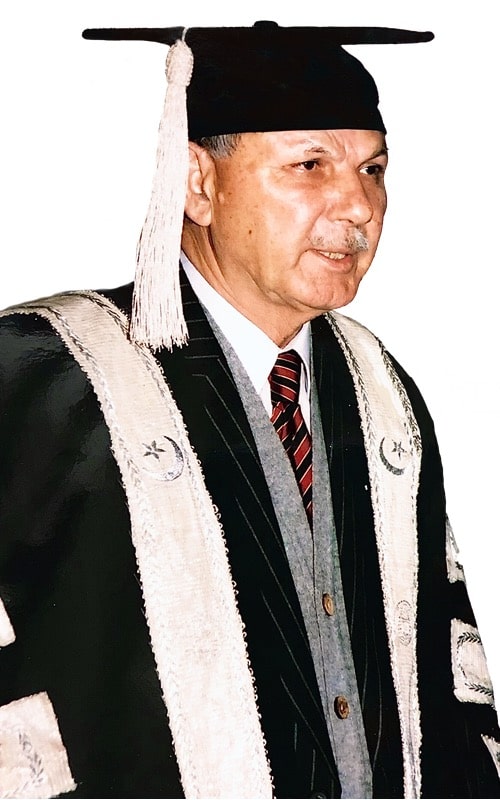
Lieutenant General Arshad Mahmood, HI(M), SJ (Retd.) was born in August 1940 in Kotli, Azad Kashmir. He received his early education from Faiz-ul-Islam High School, Rawalpindi, and Bachelor’s degree from Government College, Lahore. Later, he earned two Master’s degrees from Quaid-e-Azam University, Islamabad, one in Military Policy and Operational Strategy (1980–81) and another in Defence Studies and National Policy (1990–91).
He began his military journey in 1961 by joining the Pakistan Military Academy and was commissioned in the Artillery in April 1964. During the 1965 war in the Khem Karan Sector, he showed remarkable courage and was awarded the Sitara-e-Jurrat for gallantry. Despite serious injuries, he continued to fight and helped repel the enemy advance. His regiment, the 35 Heavy (Self-Propelled) Artillery, earned the title “Sherni” for its decisive impact in battle.
Over a distinguished 37-year career in the Pakistan Army, he held many Command, Staff, and Instructional positions, including three years in Qatar leading the Pakistan Army Advisory Team to train their armed forces. Promoted to Lieutenant General in 1995, he retired from service in 1997 after a career marked by integrity, discipline, and professional excellence.
After retirement, he served as Managing Director of the Overseas Employment Corporation and later as Vice Chancellor of the University of the Punjab (1999–2007). His eight-year tenure at Punjab University is remembered for visionary reform, academic renewal, and moral leadership that transformed one of Pakistan’s oldest public institutions.
His book Legacy Beyond Leadership reflects this lifelong journey of service, reform, and moral purpose.
Author's Perspective
Why Legacy in the Title?
The word Legacy has always held a deep meaning for me. It is not only about what we leave behind, but how we navigate life. Our purpose, values, and the impact we have on others through every role we perform in life. To me, legacy should be worked backwards from the fulfilment of a larger life goal or purpose.
I often shared this thought during my tenure at the University of the Punjab, raising my right hand, saying: we have four fingers and a thumb, and we should be able to use our thumb to count our blessings and achievements on at least two or three fingers. I would remind my colleagues that when they leave this place, they must reflect on how they would like to be remembered, and how they would narrate their life’s story to their children and grandchildren.
And finally, when we leave this world and meet our Creator, how will we connect our blessings with our achievements? As the Qur’ān reminds us in Surah Āle ‘Imrān (3:30):
“The Day is approaching when every soul shall find itself confronted with whatever good it has done and whatever evil it has wrought. It will then wish there is a wide space between it and that Day! Allah warns you to beware of Him; He is most tender towards His servants.”
This reflection lies at the heart of Legacy Beyond Leadership, as I see it, it is a journey of conscience, gratitude, and moral responsibility.
Excerpts from 15th Chapter
Foundation of Virtuous Leadership
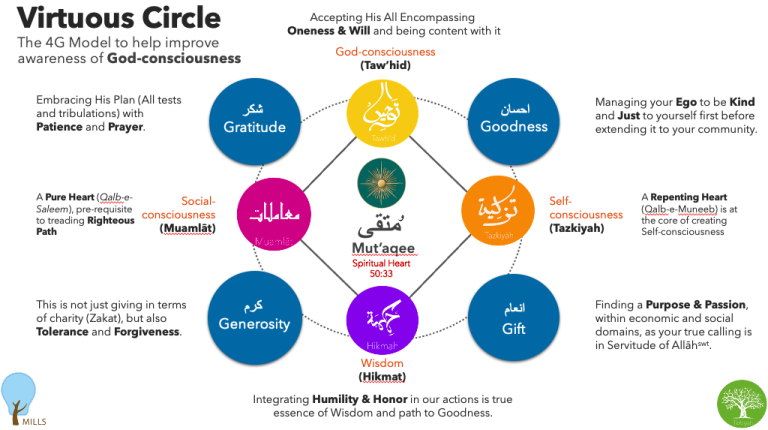
4G Model of God-consiousness as foundation for Virtuous Leadership
Excerpts from Chapter 15: ‘I will be sharing my practices during my tenure as Vice Chancellor within each of these elements so as to bring the bigger picture together for my readers around the subject of Virtuous Leadership. It is important to note here that the first three elements i.e. God Consciousness, Social-consciousness and Self-consciousness are shared as aspired ‘conscious’ states, however each of these elements exist at 3 levels i.e. awareness, literacy and consciousness.
These three elements can be positioned over two axes, level of knowledge and level of action. Awareness hence is just knowing not believing and not acting upon it, while Consciousness is integrating the concept as a belief and putting it into daily practice. The fourth element i.e. Wisdom is of a different nomenclature and requires three separate sub-elements to take shape i.e Knowledge, Recognition and Reflection added to access Wisdom. I will briefly explain each of these four elements as part of a Virtuous Leadership model before sharing best practices during my career with the readers.’
Excerpts from Reflections
Leading Change
This book is an effort to share my experiences of driving and leading change within a mammoth public sector organization, as an outsider. I will be taking my readers through my life experiences, woven around change that I brought to one of the largest public sector organizations in Pakistan. I will try my best to share my journey from creating the need and urgency for change to winning hearts and minds of those who were instrumental in helping deliver this change. I wish to share a 360 degree view of change management including all dimensions of Virtuous Leadership which are desired for a change leader in Pakistan’s public sector context. This book is divided into four major sections, other than my biography which his intertwined: identifying and creating need for change, driving awareness and acceptance within the ranks, building a shared vision and committed consensus and finally sustaining change by instituting it within the organization.