
From Friction to Facilitation | Amanāh Series UET Lahore:
Reframing the Role of Academic Administration in Universities
The Amanāh Series UET Lahore reflects how academic administrators form the invisible structure that holds a university together. They are the first and last contact for students, the silent enablers of faculty, and the ones who keep the system moving. Yet, their roles are rarely celebrated or understood as part of the leadership fabric of a university.
MILLS™ Skills, a research-based social enterprise, is the strategic partner of UET Lahore in curating and rolling out the Faculty and Staff Development Program (FSDP). The Vice Chancellor, Prof. Dr. Shahid Munir, SI, envisioned FSDP as a shared platform for both faculty and ministerial staff to grow together. Under the leadership of Dr. Aneela Anwar, faculty and staff workshops are curated and delivered independently, with the Amanāh Series designed specifically for ministerial and administrative staff.
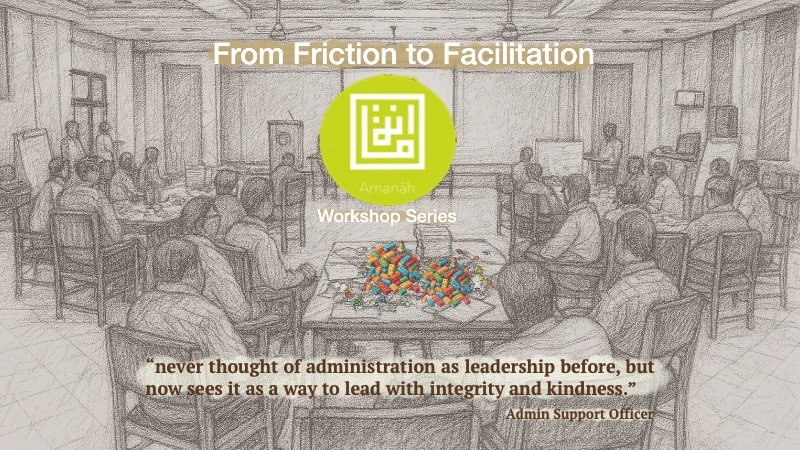 The Amanāh workshop, titled From Friction to Facilitation, brings together academic administrators from grades 10 to 17, many with over fifteen years of experience. Engaging such seasoned professionals requires more than lectures or checklists. The design blends reflection, dialogue, and experiential learning through LEGO® Serious Fun and LEGO® Serious Play™ pedagogies. The first helps participants bond through shared play and laughter, while the second turns abstract ideas into tangible models. As they build together, they begin to see themselves and their teams in a new light.
What is Amanāh (أمانة)?
The word Amanāh (أمانة) comes from the Arabic root أمن (amina), meaning to feel safe, to be reliable, to be trustworthy. It represents faithfulness, honesty, integrity, and moral responsibility. In the Qur’an, Amanāh is described as a trust or duty placed upon human beings, something that must be upheld with sincerity and accountability. It is not limited to possessions or promises but extends to one’s role, influence, and conduct.
يَـٰٓأَيُّهَا ٱلَّذِينَ ءَامَنُوا۟ لَا تَخُونُوا۟ ٱللَّهَ وَٱلرَّسُولَ وَتَخُونُوٓا۟ أَمَـٰنَـٰتِكُمْ وَأَنتُمْ تَعْلَمُونَ ٨:٢٧
‘O you who have believed, do not betray Allāh and the Messenger or betray your trusts while you know [the consequence].’ Qur’ān Al-Anfāl 8:27
In essence, Amanāh is the divine trust within every human role, a responsibility to act with reliability, humility, and conscience in all that we are entrusted with. It reminds us that our work, whatever its nature, is a trust from God and a service to others. The Amanāh workshops invite participants to rediscover this sense of purpose in their daily work. They are part of UET’s broader effort to foster holistic development, where learning is not limited to classrooms but extends to every corridor of the institution.
LEGO Pedagogy – Metaphors for Amanāh Series UET Lahore
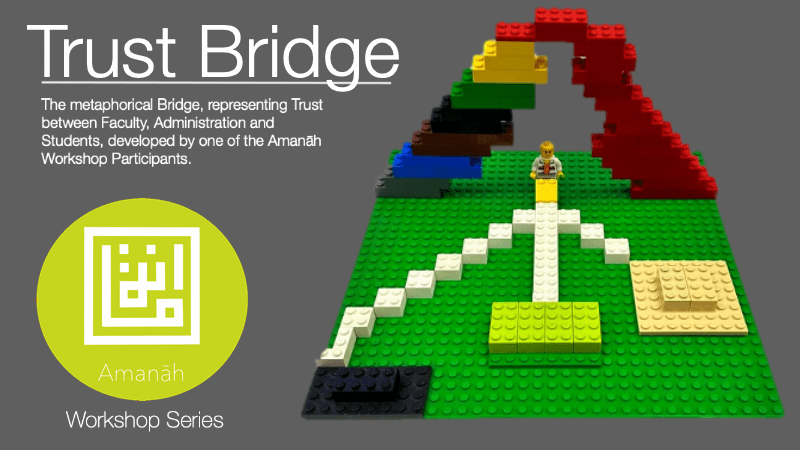
In one of the Amanāh workshops at the University of Engineering and Technology Lahore, a participant built a model with LEGO bricks to describe what trust looks like in their workplace. It showed a small figure standing on a bridge, connecting two sides under an arch of bright colors. When asked to explain, the participant said it represented the trust and connection between faculty and students, held together by the often unseen efforts of academic administrators. That simple model captured the spirit of the Amanāh initiative, a reminder that universities function not only through systems and structures but through people who quietly carry the weight of that trust every day.
 The sessions explore Virtuous Leadership Triangle of Compassion, Connection, and Courage, and contrast it with what we call the Vicious Triangle, a cultural pattern shaped by blame, shame, and fear of failure. This vicious cycle often limits communication and collaboration within and across departments. Through guided reflection, participants identify where these barriers exist in their own teams and how small behavioral changes can begin to replace them with trust and respect.
Every Amanāh workshop combines group discussions with individual reflection sheets, helping participants connect concepts with their personal experiences. Many realize how their tone, patience, or responsiveness can directly influence the working climate of a department. One participant shared that he had “never thought of administration as leadership before, but now sees it as a way to lead with integrity and kindness.”
This quiet shift is the real outcome. The Amanāh experience is not about changing job descriptions, but about rediscovering meaning in everyday responsibilities. It celebrates those who serve behind the scenes, the ones who process admissions, manage laboratories, handle student records, or support faculty operations with diligence and humility. Through Amanāh series UET Lahore has reaffirmed that leadership is not limited to titles or positions. It is reflected in how we treat others, solve problems, and uphold trust.
As the third cohort concludes, the atmosphere in the training hall is often one of reflection and renewed energy. The bridge of trust, once built with LEGO bricks, now exists in conversation, in listening, and in the shared realization that every role has purpose.
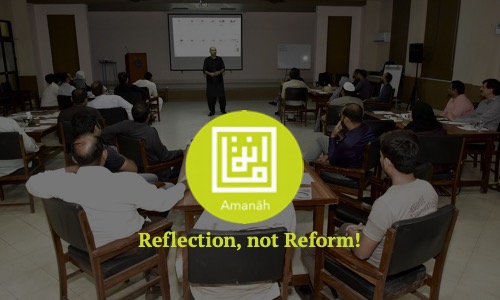
Programs like Amanāh remind us that real transformation in universities begins with reflection, not reform. When people feel seen, trusted, and valued, systems begin to change from within.
May we continue to find meaning in service, and dignity in the quiet work that holds our institutions together.